


Table of Contents
Modern businesses depend on websites, cloud apps, and SaaS records to keep daily work moving. Email, social accounts, backups, and customer portals support the same daily operations. That is why “what is cyber vandalism” matters now. Cyber vandalism is intentional digital damage or disruption. It can look like a changed homepage before a launch, a wiped shared folder before billing closes, or a fake post from a hijacked account. The FBI Internet Crime Complaint Center received 880,418 complaints in 2023 and reported losses exceeding $12.5 billion, which shows why fast recognition protects daily operations.
Willis Cantey, CEO at Cantey Tech Consulting, notes: “Treat visible damage as the first clue, not the full incident. Check access logs, backups, admin accounts, and connected systems before restoring anything.”
Cyber Vandalism Definition For Everyday Business Systems
The cyber vandalism definition is broader than website graffiti. It includes unauthorized changes to websites and files. It also covers records, devices, accounts, cloud tools, and networks. Defacement activity represented roughly 35 percent of all incidents observed. In one March 2025 campaign, attackers compromised 150,000 websites. Researchers also analyzed 780 hacktivist attacks in 2024 alone, including site defacements tied to political or social messages. Examples help separate a minor inconvenience from a real security incident.
Key examples of this include:
-
Defaced public website: A homepage is replaced with hostile text before a product launch.
-
Deleted finance files: A folder with vendor invoices disappears from shared storage.
-
Hijacked social posts: A company account publishes fake refund instructions.
-
Offline business systems: A portal stops accepting customer requests.
Visible damage should trigger an investigation because it can point to deeper unauthorized access.
Computer Vandalism Beyond Website Defacement
Computer vandalism means damage to endpoints, servers, files, and applications. It can also affect business devices. A payroll laptop, accounting workstation, shared drive, or scheduling server can become the target. The result is not just a missing file. It is a workflow that no longer produces trustworthy output.
A corrupted invoice folder can delay payment runs. A disabled point of sale device can stop a front desk from closing transactions. An altered customer record can send a technician to the wrong site. A wiped shared drive can stall a deadline.
That is why prevention starts with access paths and recovery readiness. The practical focus areas are identity controls, patching, backups, and activity logs. Those controls help teams limit damage and restore files. They also show what changed when a device or system stops behaving as expected.
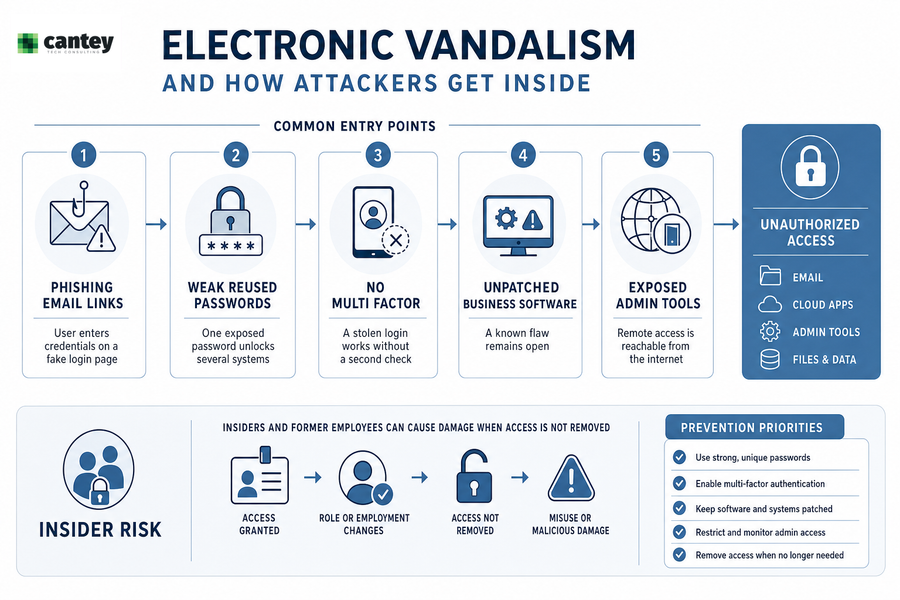
Electronic Vandalism And How Attackers Get Inside
Electronic vandalism often starts with ordinary access failures rather than advanced attacker skill. One reused password can open email, files, cloud apps, and admin tools. Verizon reported that exploitation of vulnerabilities as an initial access step for breaches increased 180 percent from the prior year, which makes patching a business priority. Access paths matter because the same login can reach email and files. It may also reach cloud apps and admin tools.
Examples of this idea are:
-
Phishing email links: A user enters credentials on a fake login page.
-
Weak reused passwords: One exposed password unlocks several systems.
-
Missing multi-factor authentication: A stolen login works without a second check.
-
Unpatched business software: A known flaw remains open.
-
Exposed admin tools: Remote access is reachable from the internet.
Insiders and former employees can also cause damage when access is not removed promptly.
Protect Against Digital Disruption
Data Vandalism Definition And Why Altered Records Are Risky
The data vandalism definition means unauthorized changes that make records incomplete, inaccurate, deleted, or unsafe to trust. This differs from pure theft, although theft can happen in the same incident. IBM reported that the global average cost of a data breach reached $4.88 million in 2024. Altered data creates uncertainty across sales, finance, service, and compliance workflows.
Key examples of this include:
-
Untrusted customer records A changed address can send shipments or technicians to the wrong place.
-
Incorrect invoices or orders Altered pricing or quantities can trigger billing disputes.
-
Broken reporting and approvals Managers may approve budgets using bad data.
-
Possible notification duties Legal and insurance review may be needed when regulated or sensitive information is involved.
Stop Digital Damage Before It Spreads
Cyber vandalism can disrupt websites, files, and daily workflows. Cantey Tech Consulting helps you strengthen detection, response, and recovery.
What Is Cybervandalism? Compared With Theft And Ransomware
So, what is cybervandalism? It is a behavior category, not one attack tool. The common thread is intentional damage, alteration, or disruption. Real incidents overlap when malware, ransomware, data theft, or denial of service activity hits the same environment. Cloudflare reported mitigating 21.3 million DDoS attacks in 2024. Cybersecurity Ventures predicted global cybercrime costs would grow by 15 percent per year over the past five years. These categories often overlap in real incidents.
Examples of this idea are:
-
Damage without theft: A website is defaced, but no customer data leaves.
-
Theft plus damage: Records are copied, then deleted to slow discovery.
-
Ransomware with destruction: Files are encrypted, then backups are targeted.
-
Disruption without data loss: A portal is knocked offline during renewals.
A defaced page or deleted file is not cosmetic when it affects customer records, invoices, approvals, or daily systems.
What Is Cyber Vandalism In A Real Response Plan
Response gets difficult when no one knows who owns websites and cloud apps. Backups, vendor portals, and insurance communication may have separate owners. A support ticket may start with marketing, then move to IT and leadership as the scope becomes clear. The response goal is to contain damage and prove what can still be trusted.
Key examples of this include:
-
Isolate affected systems: Remove compromised devices or accounts from production access.
-
Preserve useful evidence: Save screenshots, timestamps, alerts, and ticket notes.
-
Change exposed credentials: Reset passwords and revoke suspicious sessions.
-
Review activity logs: Check admin actions, file changes, and login locations.
-
Restore and validate backups: Confirm restored files are clean and current.
Document each step for insurance, legal, and internal leadership review.
Cyber Vandalism Prevention And Recovery Support
Unauthorized digital damage is a warning sign that access, records, backups, or public channels may be compromised. Organizations that need help with assessment and monitoring can contact Cantey Tech Consulting. Cantey Tech Consulting can also support response planning and recovery work.
With over 15 years of cybersecurity experience and more than 350 clients, Cantey Tech Consulting offers practical guidance for turning a confusing incident into a documented recovery path. That path should protect users, data, and daily work before anything unsafe is restored.