


Table of Contents
Finance needs invoice data before the cutoff. Managers need current reporting before approving staffing. Employees need shared records without copying files across devices. Customers expect responsive service when your team is busy.
Willis Cantey, CEO at Cantey Tech Consulting, notes: “Start with the workflow, then design the database around access, recovery, reporting, and support so users get current data without creating new risk.”
That is where the advantages of cloud database planning become operational, not abstract. IDG reported that 71% look to the cloud for speed improvements, 63% want flexibility, and 57% prioritize improved customer support. With the right plan, cloud databases benefits become cleaner workflows, safer access, fewer ticket escalations, and stronger uptime.
Cloud Database Advantages That Reduce Daily Workflow Friction
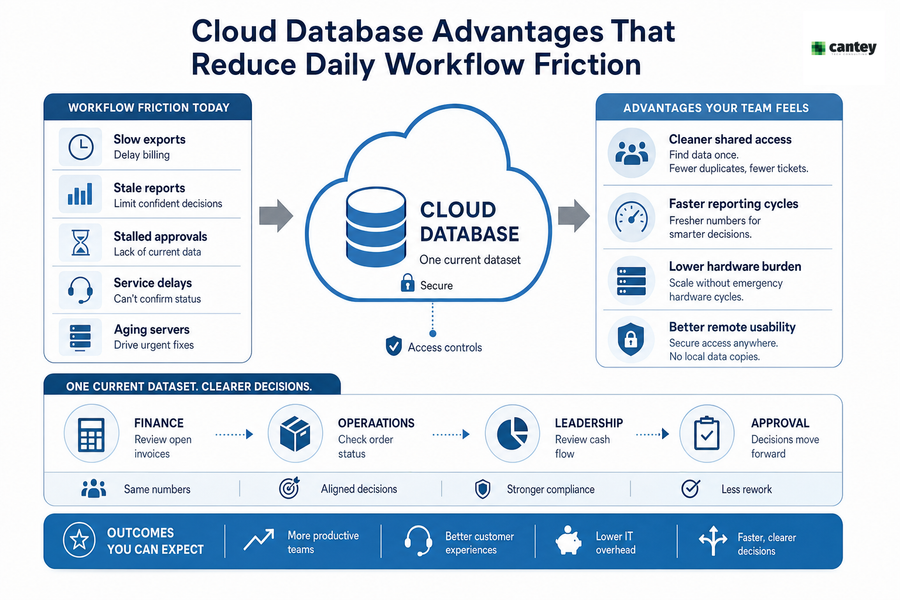
Slow databases do not stay inside IT. They show up when billing waits on invoice exports, managers refresh stale reports, approvals stall, and customer service cannot confirm order status while the customer is on the phone.
Your teams need a shared source of current information that matches how work moves through billing, approvals, reporting, and support. Survey respondents using data lakehouse architecture reported a 33% productivity improvement. IDG also found that 71% look to cloud for speed improvements, 63% want flexibility, and 57% choose cloud for improved customer support.
-
Cleaner shared access: Teams spend less time hunting for the right spreadsheet, export, or archived file. That reduces duplicate records and follow-up tickets.
-
Faster reporting cycles: Managers work from fresher numbers for staffing, inventory, cash flow, and service capacity decisions.
-
Lower hardware burden: Aging servers stop driving emergency replacement decisions when storage or performance tightens.
-
Better remote usability: Authorized staff can work securely without copying sensitive customer or invoice data onto personal devices.
Picture finance reviewing open invoices while operations checks order status and leadership reviews cash flow from the same current dataset. The approval path is clearer because everyone sees the same numbers before decisions move forward.
Business Outcomes Behind The Advantages Of Cloud Database
Cloud database value shows up in daily business routines, not just IT architecture. When analysts can access and analyze data from multiple sources more efficiently, survey respondents reported a 35% productivity improvement for data analysts. Developers in the same research reported a 33% productivity improvement tied to ML and AI integration, troubleshooting, data access, and collaboration.
The benefits of cloud databases become clearer when you connect them to repeated work.
-
Fewer unresolved data issues: Centralized data reduces duplicate customer records, mismatched invoice fields, and confusion over which file is current.
-
Faster employee access pathways: Authorized users get records without waiting for a manual export or file transfer. Less waiting keeps approvals and customer handoffs moving.
-
Stronger backup discipline for recovery: Managed backup planning supports recovery when a file is deleted, a sync fails, or an outage interrupts work.
-
Clearer leadership reporting cycles: Current data helps leaders make budget, staffing, and service decisions without reconciling three report versions.
-
More controlled permissions by role: Finance, HR, operations, and leadership receive access based on role. That protects payroll, invoice, customer, and operational data.
At Cantey Tech Consulting, support reliability matters because database issues affect active work. Our service desk averages a 1.57-minute phone response time and delivers 75% first-call resolution across practical IT needs.
Cloud Databases Benefits For Security And Compliance Readiness
Sensitive data moves constantly. An employee updates a customer record, a vendor portal receives invoice details, a reporting tool pulls sales data, and leadership reviews payroll trends. With nearly half of the world’s data in external data centers representing 200 zettabytes, cloud database security has to be designed around daily access.
A cloud database still needs strong configuration, monitoring, access control, and policy discipline. One loose permission can expose records that finance, HR, operations, or customer service teams rely on.
-
Role-based access: Only the right people see invoice, payroll, customer, or operational data.
-
Continuous monitoring: Unusual logins, odd transfers, and access attempts are easier to detect and address.
-
Patch discipline: Database environments stay current, which reduces avoidable exposure from known issues.
-
Backup validation: Recovery plans are tested against real needs, such as month-end billing or customer service uptime.
-
Policy alignment: Controls support CMMC, NIST, HIPAA, PCI, and SOX requirements when those frameworks apply.
Security planning becomes easier when technical controls match how your teams work. We support access management, endpoint protection, backup planning, and employee training as part of customized security planning.
More On Cloud Strategy
Benefits Of Cloud Databases During Growth And System Change
Growth puts pressure on data. You add users, open a location, connect a new cloud application, or ask managers for deeper reporting by product line. Database decisions should support change without creating workarounds that live in inboxes and spreadsheets.
Gartner estimates that by 2027, 70% of enterprises will use cloud platforms to optimize business initiatives, a 55% increase from 2023. IDG also found that 71% look to cloud for speed improvements, 63% want flexibility, and 57% prioritize improved customer support. The cloud computing market is projected to grow from USD 1,294.9 billion in 2025 to USD 2,281.1 billion by 2030 at a 12.0% CAGR, so planning now helps protect you from fragmented systems later.
-
Scalable user demand planning: More employees and workloads can be supported without constant server upgrades. Approval decisions stay tied to growth plans instead of emergency capacity fixes.
-
Cleaner application connections across tools: Business apps share customer, invoice, inventory, and reporting data more consistently. Fewer manual imports mean fewer errors.
-
Better project planning discipline: vCIO guidance helps leaders understand dependencies before approving IT investments. We assign vCIOs to MSP/CSP accounts for roadmaps, QBRs, project management, and IT budgeting.
-
Less internal IT strain: Internal staff can focus on higher-value projects instead of repetitive access fixes and report repairs.
Plan before you migrate. The strongest cloud database benefits come from matching the platform to workflows, permissions, support, and budget approval steps.
Plan A Smoother Cloud Database Move
Turn cloud database benefits into cleaner workflows, safer access, and stronger uptime with guidance from Cantey Tech Consulting.
Cloud Database Benefits You Can Turn Into Next Steps
Moving database workloads affects people, processes, permissions, reporting, and support routines. It is not just a hosting choice. The cloud market continues to expand at 35 percent annually, which makes practical planning more important as vendors, apps, and AI tools keep changing.
Before you act, map the business impact. Cloud database advantages are strongest when access rules, backup expectations, and ticket processes are defined before the first migration task.
-
Map which teams use which data, including finance, operations, sales, leadership, and service staff.
-
Identify sensitive records and define who approves access for payroll, invoices, customer files, and reports.
-
Review backup, recovery, and retention expectations against deadlines like billing close or payroll submission.
-
Document which applications must connect to the database, including accounting, CRM, ERP, and reporting tools.
-
Build a support process for tickets, escalations, user training, and post-migration questions.
Start with the workflow.
If you want a practical path forward, contact Cantey Tech Consulting for an assessment of your database workflows, permissions, backups, security controls, and long-term IT plan. We bring over 25 years of IT experience, support 350+ clients, provide local on-site support, and align cloud planning with vCIO guidance and customized security recommendations. Your finance cutoff, reporting cycle, ticket flow, and customer response process all get considered before your database move creates new friction.