


Table of Contents
Underwriters now ask sharper questions before approvals, renewals, and invoices move forward. They want MFA on email and cloud apps, reliable backups, endpoint protection, incident response steps, employee training, vendor access controls, and business continuity plans. Even in a buyer-friendly market where 2023 rates decreased by an average of 17 percent, your evidence still matters.
When you ask how much does cyber insurance affect your budget, the answer starts with daily IT discipline. Breach costs averaged $2.7 million across surveyed organizations, so cyber insurance costs connect directly to downtime exposure, renewal paperwork, and customer data protection.
Willis Cantey, CEO at Cantey Tech Consulting, notes: “Treat the application like an audit of your daily habits, because clean tickets, tested backups, and trained employees give underwriters evidence they can use.”
Why Cyber Insurance Costs Are Tied To Daily IT Discipline
Insurers price risk based on visible controls and documented behavior, not just company size. A larger team with weak records can look riskier than a smaller team with clean tickets, tested backups, and clear approval paths.
These factors affect underwriting because they show whether your controls work during normal business activity and at renewal time.
-
MFA coverage scope: Email, VPN, admin accounts, and cloud apps need MFA that is documented, enforced, and reviewed when employees change roles.
-
Endpoint detection coverage: Laptops, servers, and remote users need EDR monitoring so suspicious activity becomes a ticket, not a missed alert.
-
Backup restore proof: Restore testing and continuity planning show how quickly invoices, files, and customer records can come back online.
-
Training and workflows: Security awareness training helps employees pause before approving payment changes or opening risky attachments.
What this looks like in practice. A finance employee receives a vendor bank change request before approving invoices. A suspicious email becomes a help desk ticket. A restore test before renewal proves backup data is usable.
Proof matters. We connect that proof to capabilities your team can maintain every week, including proactive threat detection, patch management, backup management, and employee cyber awareness training.
|
Evidence Area |
Operational Artifact to Maintain |
Owner |
Underwriting Red Flag |
|---|---|---|---|
|
Identity control coverage |
Monthly Azure AD or Okta export showing MFA enforced for Microsoft 365, VPN, privileged accounts, and finance cloud applications |
Systems Administrator with IT Director review |
Shared admin accounts, excluded executives, or unmanaged SaaS logins without conditional access policies |
|
Endpoint monitoring |
EDR console report showing active agents on CFO laptop, file servers, remote sales devices, and terminated-user machines |
Security Analyst and Service Desk Manager |
Devices offline for extended periods, missing agents after laptop replacement, or alerts closed without ticket notes |
|
Backup recoverability |
Scheduled restore test record for payroll database, ERP files, and executive email archive with screenshots and elapsed recovery time |
Infrastructure Engineer with Operations approval |
Backup jobs marked successful but no restore validation before renewal documentation is submitted |
|
Employee decision points |
Training completion log plus help desk tickets for invoice-change verification, suspicious email reporting, and credential reset requests |
HR Coordinator and Service Desk Lead |
Finance approvals handled only by email, no callback procedure, or phishing reports resolved outside the ticketing system |
|
Patch and exception handling |
Patch management dashboard with approved deferrals for line-of-business servers, vendor dependencies, and scheduled maintenance windows |
IT Manager with Department Head signoff |
Critical patches deferred indefinitely, unsupported operating systems in production, or no business owner tied to exceptions |
How Much Does Cyber Insurance Depend On Your Security Controls
Premiums, coverage limits, exclusions, and deductibles are influenced by how well your team can prove control maturity. Underwriters look for repeatable processes, not a one-time cleanup before renewal.
-
Access control maturity: Admin rights should be limited, MFA should protect key systems, account reviews should happen on schedule, and offboarding should remove access before the final paycheck clears.
-
Incident response readiness: Your team needs to know who opens the ticket, who approves containment, and how escalation works after an EDR alert or suspicious login.
-
Data protection practices: Encryption, customer data handling, mobile device management, and secure email all affect how safely files move between employees, clients, and vendors.
-
Evidence and documentation: Policies, training records, audit logs, vulnerability reports, and backup tests turn daily work into renewal evidence.
Market pricing has improved, with U.S. pricing down 4 percent in Q2 from a year ago, but service reliability still depends on how fast issues become documented action. Our 1.57-minute average response time helps keep tickets moving when evidence and timing matter.
Next, look at where insurers see risk across the business itself.
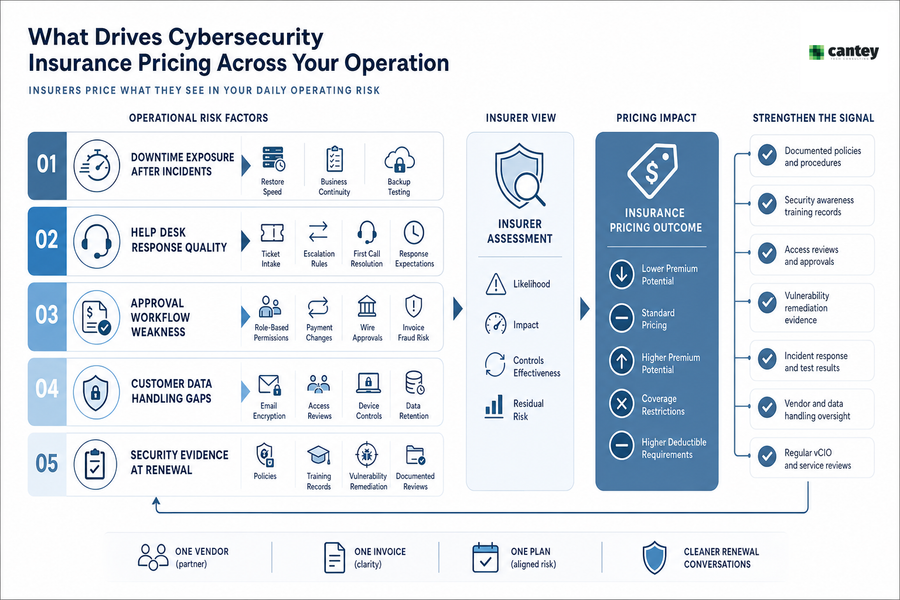
Cost How Much Does Cybersecurity Insurance Really Reflect Across Your Operation
Cybersecurity insurance pricing reflects the operational risk an insurer sees across people, process, data, and IT systems. When teams search “cost how much does cybersecurity insurance,” they are usually trying to connect the quote to daily operating risk. That connection shows up in tickets, approvals, backups, access reviews, and customer communication.
-
Downtime exposure after incidents Restore speed, business continuity plans, and backup testing show whether your team can keep payroll, orders, and shared files moving after an incident. Ransomware cost reports to IC3 increased 74% in 2023.
-
Help desk response quality Ticket intake, escalation rules, first-call resolution, and response expectations shape how quickly a bad login or malware alert gets contained. Our 75% first-call resolution rate reflects the value of getting support moving early, with a certified service desk technician acting as a direct point of contact.
-
Approval workflow weakness Invoice fraud, payment changes, wire approvals, and role-based permissions show whether finance workflows rely on memory or documented checks.
-
Customer data handling gaps Email encryption, access reviews, device controls, and data retention determine who can open customer files and where copies live. When controls are scattered across vendors and unmanaged devices, renewal answers take longer to prove.
-
Security evidence at renewal Policies, training records, vulnerability remediation, and documented reviews help your vCIO and service delivery team connect one vendor, one invoice, and one plan to cleaner renewal conversations.
Strengthen Controls Before Renewal
Cost How Much Does Cyber Liability Insurance Cost After A Security Review
Organizational change is hard because access rights, ticket habits, approvals, old devices, and training records often live in different places. Your insurance questionnaire may ask for one answer, while your evidence sits across email, endpoint tools, backup logs, and HR workflows. Start early.
A review should turn uncertainty into a prioritized action plan.
-
Review renewal questionnaires early: Read the insurance questions before renewal so MFA gaps, unsupported devices, missing policies, and backup concerns surface while there is time to fix them.
-
Confirm core controls: Validate MFA, EDR, backups, patching, and admin access controls against real systems, not last year’s spreadsheet.
-
Run a tabletop exercise: Assign named roles for who opens the ticket, who approves containment, who contacts leadership, and who tracks customer communication.
-
Build a remediation roadmap: Set owners, dates, and budget ranges so security work fits into planning, QBRs, and operational priorities.
When your team searches “cost how much does cyber liability insurance cost,” the better first step is a technical assessment that shows what needs to change before the next renewal. We use an in-depth review to turn scattered findings into practical security planning, vCIO guidance, budget ranges, and a long-term roadmap without pushing work your operation does not need.
Cybersecurity service pricing varies by company size, technical challenges, and required services. Monthly costs typically range from hundreds to thousands of dollars, and personalized quotes are available upon request.
Prepare Your Controls Before Renewal
Cantey Tech Consulting helps align MFA, backups, endpoint protection, and documentation with the evidence underwriters expect.
Talk Through Cyber Insurance Coverage Costs With A Practical Security Partner
Insurance readiness improves when you can prove strong controls, documented workflows, trained employees, monitored endpoints, reliable backups, and fast support. That proof comes from everyday records: help desk tickets, restore tests, training logs, access reviews, approval paths, and remediation notes your team can find before renewal.
If you want a clearer view of your cybersecurity posture, insurance readiness, and next steps, contact Cantey Tech Consulting for a focused review that connects risk reduction to real operating work. Bring the questionnaire. Call (843) 892-6221 to talk through your current controls, renewal questions, and a plan your team can maintain.